
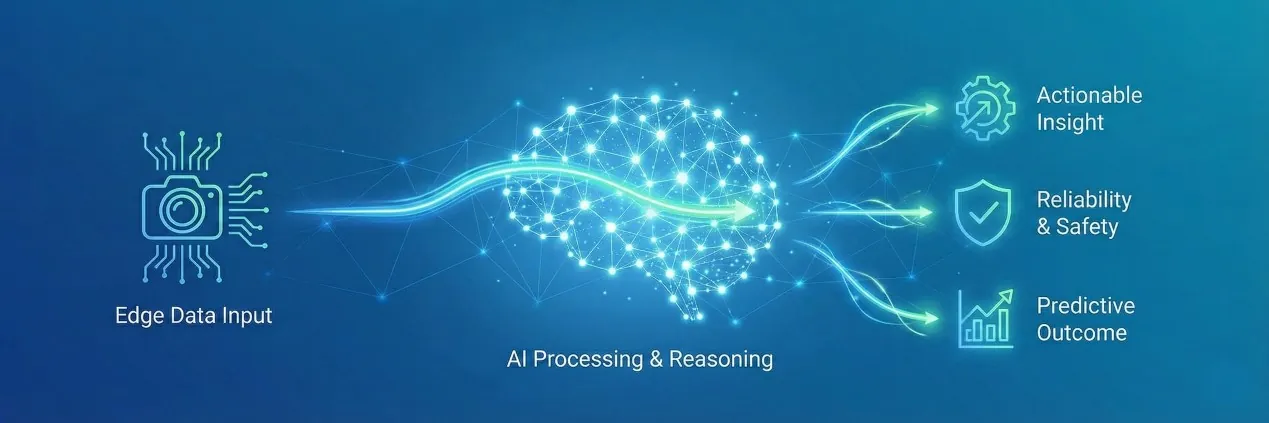
For decades, traditional computer vision systems have been highly effective at answering “what” is present in an image—detecting objects such as vehicles, people, or defects. However, these systems lack the cognitive capability to interpret context, explain why observed details matter, or reason about what actions should follow.
A new paradigm is emerging: Agentic AI powered by Vision Language Models (VLMs). By integrating VLMs with Large Language Models (LLMs) and Retrieval-Augmented Generation (RAG), edge AI systems evolve from passive observers into autonomous reasoning agents capable of understanding, interpreting, and acting upon complex visual environments.
Agentic AI with VLM Reasoning
Agentic AI systems extend far beyond traditional perception by combining visual understanding with language-based reasoning and contextual memory.
Core Capabilities
- Perception with Reasoning
Processes high-resolution video streams and applies multi-step logical reasoning to respond to open-ended, situational queries.
- Contextual & Narrative Intelligence
Moves beyond bounding boxes and alerts by generating accurate, explainable narratives that describe what is happening, why it matters, and what may happen next.
- Searchable Visual Intelligence
Automatically transforms unstructured video into rich, indexed metadata. Operators can query video feeds using natural language, such as: “Show all incidents where safety equipment was removed near active machinery.”
Key Applications
Deploying Agentic AI with VLM reasoning at the edge enables transformative outcomes across critical industries:
- Smart Manufacturing & Factory Inspection
Rather than binary pass/fail inspection, Agentic AI continuously evaluates visual and operational context. It can correlate subtle surface discoloration with abnormal vibration patterns to infer early-stage equipment degradation—enabling predictive maintenance and preventing costly unplanned downtime.
- City Safety & Intelligent Traffic Management
VLM-powered agents provide situational awareness beyond conventional video analytics. They can distinguish between illegal parking and a vehicle immobilized by an accident, or identify anomalous pedestrian behavior near high-risk intersections—triggering real-time alerts to improve public safety and traffic flow.
- Critical Infrastructure Monitoring
In energy and utility networks, visual anomalies are often nuanced. Agentic AI analyzes drone and fixed-camera footage to assess structural integrity—differentiating between cosmetic surface debris and critical stress fractures, corrosion, or vegetation encroachment—ensuring the resilience and reliability of power grids and pipelines.
Why Edge Servers Are Essential for Agentic AI
While cloud platforms offer scalability, Agentic AI with VLM reasoning demands edge-native deployment due to its real-time, data-intensive nature.
- Data Privacy & Sovereignty
Video streams in factories, cities, and infrastructure environments often contain sensitive or regulated data. Edge processing ensures compliance with data sovereignty requirements, GDPR, and enterprise security policies by keeping data on-premises. - Ultra-Low Latency Decision-Making
Safety incidents and production anomalies require immediate response. Edge inference eliminates cloud round-trip latency, enabling real-time action where milliseconds matter. - Bandwidth Optimization
Continuously streaming high-definition video to the cloud is costly and impractical. Edge servers process raw video locally and transmit only high-value insights and metadata, dramatically reducing bandwidth consumption.
ECA-6050: Powering VLM Reasoning at the Edge
To meet the intensive computational demands of Vision Language Models and real-time agentic reasoning, Lanner ECA-6050 delivers data center–class AI performance at the edge.
Lanner ECA-6050 Key Highlights
- High-Density Edge AI Compute:
A 2U rackmount AI GPU server engineered to deploy advanced AI inference in edge and near-edge environments.
- Multi-GPU Architecture with NVLink:
Supports up to 4× NVIDIA® H200 GPUs with NVLink interconnects, delivering exceptional memory bandwidth and GPU-to-GPU communication—critical for large-scale VLM workloads.
- Accelerated & Secure Networking:
Integrated NVIDIA® BlueField®-3 DPU offloads networking functions from the CPU, ensuring deterministic performance for AI inference pipelines.